Merri’s 20th Anniversary as a Dance Caller
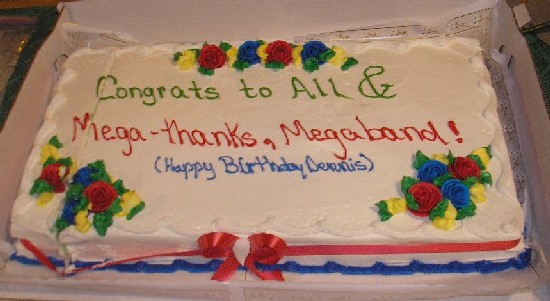
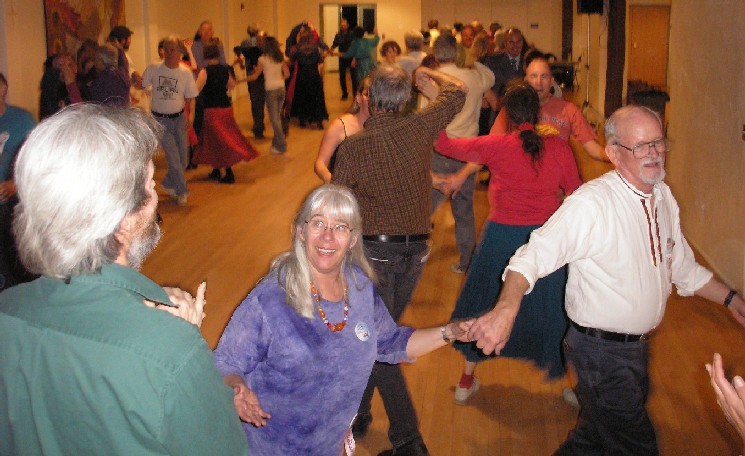
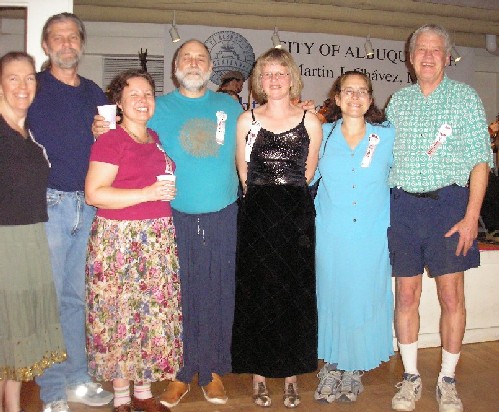
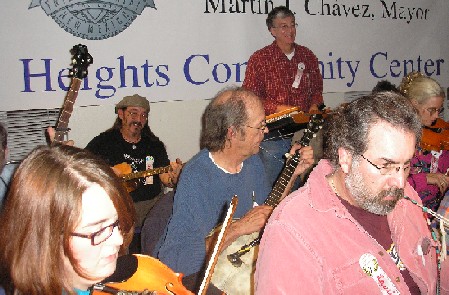
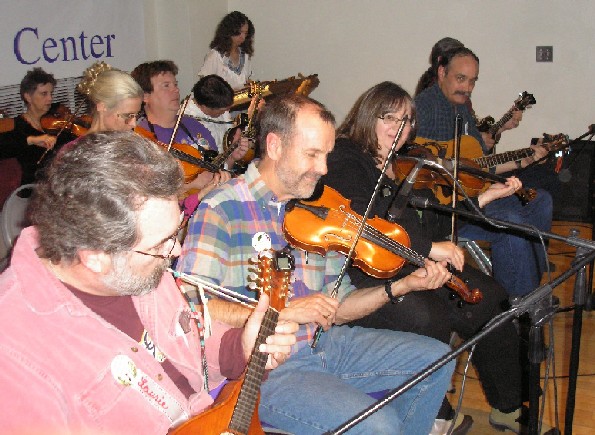
November 30, 2011 on 10:11 pm | In Albuquerque, Monthly Folk eNewsDecember 7, 2011 marks my 20th anniversary as a dance caller. I’ll be calling two dances to celebrate, one on Saturday, December 3, at the Albuquerque Square Dance Center, 7:30 – 10:30 pm with Hey! playing (I just got home from a two-hour band practice with them, and they have planned some fun surprises for the dancers). I’ll also be calling the Second Sunday English/contra dance at the Heights Community Center on Sunday, December 11, 7 – 9:30 pm in Albuquerque with Second Nature (Karina Wilson and Della O’Keefe playing, and since Gemma DeRagon played at the very first dance I called on December 7, 1991, she’ll be joining Karina and Della for this dance). Between these two dances I hope to call my top 20 dances of all time. We’ll have a big chocolate cake on December 3 and would appreciate potluck snack donations for the Second Sunday dance on December 11. If you’ve ever had fun dancing to or with me, please come help me celebrate this big anniversary. Please email or call your dancing friends and encourage them to attend. It’d be fun to have a big crowd at both dances.
I can only say this: those twenty years went quickly! I wrote a long essay in 2000 about calling. Here is a small part of it:
After I started contra dancing in 1981, I sat on the periphery of music, sometimes at a dance, sometimes a concert, sometimes around a fire in the middle of a field, or in a cabin amid piles of snow. I listened to others proliferate wonderful, rowdy, driving music and was unable to participate. I wished fervently to speak the language of music, but I never found the notes, never had any musical ability, never had a role.
Learning to call dances gave me a role. For years I admired musicians and callers and the bridges they created for the dancers. And so I learned to be a bridge. I bridge the music and the dance. I connect the players and dancers. And when it all comes together in a synergistic way, indeed, magic happens.
Getting on stage that first time in April 1991 was the greatest leap of faith I ever made. It took me more than a year to get there, fifteen months after I first attended a calling workshop with Bill "Doc" Litchman one weekend in January 1990. I could not bring myself to get on stage in front of people and interact with dancers and musicians, all alone. I practiced and struggled, and finally I stood on stage, out of excuses.
Even my non-dancing hubby Mark showed up for my debut. I gripped the microphone, I cued the band, and I called Don Armstrong’s "Broken Sixpence." Flawlessly. The dancers and musicians erupted into shouting so loud, so sustained, and so spirited that I tried calling one dance again, a few months later. On December 7, 1991, at the Lloyd Shaw Dance Center with Megaband backing me up, I called my first whole evening of dances. I only knew ten dances, and I called them all.
That first year or two of calling my knuckles stretched white and my hands ached from holding the microphone so tightly. I counted the beats of the music in my head to time my calls correctly, "1, 2, 3, 4, LA-dies CHAIN a-CROSS now…." Several years into it, I realized I knew where I was in the music, which was the second A part or the first B part, or when a tune was irregular. I became not only a dance teacher and leader, but also a band director, choosing dances to complement tunes, setting tempos, cuing the band to switch tunes, speed up, slow down, and finally stop. All of this looks easy when you gain experience. But, believe me, it’s not as easy as it looks.
Once a musician told me, "You are one of the few who thinks the musicians are important. You appreciate us."
"Important?!" I exclaimed, "It is because of you that dance is possible."
And so I became a bridge to what is possible, not a big, commercial, concrete and steel giant spanning a metropolis, but a small, wooden bridge over a babbling, musical creek. Maybe Pan plays his lute on the shore or a Civil War fiddler and banjo player tune up, leaning against an old gnarled tree. And maybe the women are there in gauzy gowns, with flowers in their hair, and the men are bowing to their favorite partner. But there I am, too, figuring out how it all fits together.
Why? Because. Because I finally have a role.
(c) 2011, Merri Rudd, All Rights Reserved
Boo Camp Photos!
November 5, 2011 on 6:51 pm | In AlbuquerquePhoto by Peter Esherick, © 2011, All Rights Reserved
Here are two links to some photos that show FOLKMADS’ recent Boo Camp, held October 28-30, 2011 at the beautiful Hummingbird Music Camp in Jemez Springs, NM. The weather and cottonwoods cooperated, and the fantastic tunes of the Privy Tippers gave the dancers much joy (as you can see from the photos).
Peter Esherick posted photos of the entire weekend at :
Boo Camp by Peter Esherick (click on a photo to get the large version, then use gray arrows to right and left of photos to move to next or previous photo)
From Saturday night’s Boo Ball, a costumed event, are Tom Hunter’s photos:
Boo Ball by Tom Hunter (click on a thumbnail to see larger version, then keyboard arrow keys will move you between photos)
Enjoy!
Farewell, Richard Wilson, August 4, 2011
August 4, 2011 on 1:29 pm | In Albuquerque(photo by Stephen C. Mills)
Richard Wilson, longtime dancer, dance caller and folk community icon, passed away peacefully today, August 4, 2011, at home surrounded by his family, wife Karolyn and daughters Emily, Karina, Lily, Laurel and Charline. Although he fought his melanoma cancer with all of his being, biology triumphed and death prevailed, as it will for each of us. Each year the anniversary of our own death passes us by with nary a blip or acknowledgement, mostly because we don’t know that day yet. Cherish life, dance often, support traditional music and dance, honor Richard’s memory by loving well and living with joy.
I first met Richard and Karolyn Wilson around the fall of 1984 at the Heights Community Center in Albuquerque, New Mexico. Emily was already born (and probably was snugged to Richard’s chest while he danced). Karolyn was pregnant with Karina and dancing away. Both Richard and Karolyn glowed while dancing together.
Soon after, Richard stepped up to fill a caller void when Pam McKeever left for New York. We were a small group. I think Mimi Stewart and Richard were the main callers back then. Then Richard took a job in California for awhile, and the family moved with him. New Mexico called him and his family back several years later. They’ve lived here ever since.
One vivid memory I have of Richard is from 1991. I was a new caller, terrified of being on stage. So I practiced and practiced and practiced to overcome my fear. I called one dance (out of an evening of dances) in Albuquerque and one dance (out of an evening of dances) in Santa Fe. The Albuquerque caller coordinator then decided I was ready to call my first whole dance—on December 7, 1991 (the 50th anniversary of Pearl Harbor Day). I saw Richard at a dance before my gig and reported that I was about to take the plunge. After hearing the date of my first whole dance, he said, with a gleam in his eye, “Well, then, it’s OK if you bomb!” We laughed and laughed, although 19 years later, he claimed to have no memory of this exchange.
Richard believed steadfastly in giving everyone access to the folk community, be it dancers, callers or musicians. No matter what the skill level of callers and dancers, he encouraged them to learn and have fun. Richard was the first caller I ever saw fly off the stage and into the dance line, calling and dancing simultaneously. Eventually, I too learned this instant access to rhythm and community.
He and I have different calling styles, but we enjoyed egging each other on. He provided an entertaining evening for all in attendance. Once, in the early 1990’s, a new and unskilled caller stood on stage for 45 minutes trying to teach a difficult dance that he did not understand. After the music started, the dance broke down and people were gathering their bags and leaving the dance hall in frustration. Richard leaped onto the stage from the dance floor, took the microphone, yelled, “Line up for a contra, no walk-through!!” and proceeded to gather everyone back into dance mode. He saved the evening. This was the only time I ever saw him assert control over a floundering individual for the good of the group. Otherwise, he reminded everyone to be kind and patient, go with the flow, and not dwell on our mistakes.
An article called “Gotta Dance!” was published in GQ magazine in December 1998. Elizabeth Gilbert wrote about rediscovering lindy hop expert Frankie Manning and going to a dance workshop taught by Frankie, who was in his 80’s by then. Gilbert wrote, “For Frankie, style, dignity, dance and romance are connected….One of Frankie’s best students said, ‘Here I am, this head-of-the-household single black mother, carrying the world on my shoulders. But when I dance with a man, I have to relax and surrender. I have to trust that, for just two minutes, this man is going to take care of me….’”
The article continued, talking about how Frankie once interrupted a class with this statement: “’Fellas, the lady you are dancing with is a queen.’ The students laughed. Frankie said it again, ‘She is a queen.’ He was serious. ‘She is a queen.’ He was going to keep saying that until we all heard him, until we all understood exactly how serious he was. The room got very quiet.”
“‘And what do you do to a queen?’ he asked. ‘You bow to her. When you’re dancing with a woman, you should be bowing to her, all the time. That’s the feeling you should have. She is letting you dance with her. You should be grateful, fellas.’”
(photo by Stephen C. Mills)
That is exactly how Richard danced and taught dance. He treated each partner as a queen. He took care of her, made her shine, guided her gently and grinned (even if the “she” was a guy dancing the woman’s part!). Then he moved on to the next partner with the same focus and flair. When teaching dance he wanted us to take care of each other. He wanted us to look beautiful. He wanted us to flow gracefully and to create synergy from music and dance. That was Richard’s goal: for us all to embrace the elegance that the marriage of music and dance evokes, to bask in the beauty of the moment.
He wanted us to have fun. He was the “pied piper” of dance leadership, often instigating long swirling, weaving, crisscrossing lines of dancers just to get people on their feet. He was a master of the grand march, directing dancer traffic into two lines of individuals, who reunited as couples, then two couples merged into a line of four, then four couples merged into a line of eight, and so on. Everyone could participate successfully and light-heartedly, as Richard subtly led them all to move effortlessly and delightedly to the music.
I’ve learned a lot from Richard, watching him teach dance, watching him share his love of dance, watching him build community whether it be a one-night-stand wedding gig or a regular dance, watching the twinkle in his eyes as he set things into motion. “Get ‘em up, get ‘em movin’” no matter age, experience, gender. Include everyone.
My most poignant Richard story occurred at New Mexico’s annual Folkmadness Music and Dance weekend in Socorro, New Mexico in 2005. Richard was supposed to teach an early Sunday morning English country dance workshop there. But he was in the middle of treatment for his cancer and was unable to do so. At the last minute, I was asked to teach the workshop instead.
To understand this story one must understand that, for almost 25 years, I disparaged English country dance. I heard birds tweeting in every tune, all of which I thought were silly. I lacked the grace and carriage to dance English well. I lacked the wisdom to understand the dance. I didn’t know it at the time, but I disgraced dance leadership.
Meanwhile, Richard loved English country dance exactly as much as I disliked it. He was the grand master of English country dance in his baby blue silk jacket with his elegance and poise, setting and turning and arming and heying with a proper English attitude. He had danced and called English country dance for years and years. He was the obvious choice to lead this workshop, not me.
Richard wasn’t a heavy-handed or judgmental leader. He was gentle. He let you make mistakes, he didn’t lecture. Maybe he believed you’d figure it out eventually on your own. I did.
In April 2004 I abruptly corrected the error of my viewpoint. I was in Nashville, TN staying with Susan Kevra and Russ Barenberg. Susan took me (apologetically, knowing my lack of enthusiasm) to a small English dance in a hot gymnasium with recorded music. She taught Jacques Latin, and I danced it with about 20 others. At the end I said to her, “That was fun!” She looked at me in disbelief, and I clapped my hand over my mouth in shock. I was suddenly inexplicably smitten by the joy, verve, grace, and fun of English country dance. I started my English dance collection that weekend, poring over Susan’s dance collection with her humming tunes to me.
I share these details so that readers appreciate the supreme irony of me substituting for Richard Wilson in leading an English country dance workshop only a year after my conversion.
So it was May 2005 at Folkmadness, and I was emergency-subbing for Richard. I was working with a band called The Cantrells (Emily and Al, more serendipity, from Nashville, TN) who used to play English tunes 20 years ago. We weren’t at all sure about our workshop, so we had a band practice, complete with dancers, under the spreading sycamore tree the day before. The Cantrells brushed up on their English tunes rather quickly; they were great musicians. I figured the workshop was early Sunday morning; usually only 20 or 30 people showed up.
There were 100 people at my workshop, including Nils Fredland, one of our guest callers for the weekend.
And it was the first time I’d ever taught English country dance. I started with Well Hall, not the best choice for a beginner’s workshop. But I had come to love that tune and dance, the many “moments” of discovery and interaction throughout the dance sequence. The music started and I was observing from the stage many flailing contra dancers trying to master a new dance style. It looked AWFUL until unexpectedly, an amazing thing happened: the music took the dancers to where they needed to be. They settled down, started floating above the floor and leading with their hearts, maximizing the moments. The transformation was beautiful to behold.
This was the only time in 20 years that I have cried on stage.
The dancers (many of whom were startled to see me teaching English) were touched that I was touched. We carried on, not flawlessly, but exuberantly, playfully, and truly in the spirit of English dance. And certainly in honor of Richard Wilson, whose name I invoked more than once.
Richard and Karolyn showed up later for lunch, and Richard sought me out to ask how my workshop went. I cried again, relating the details to him, and he seemed bemused by my emotion.
I went on to teach other English dance workshops at several weekend gigs with a mix of English and contra dance. I reminded the dancers that the great moments found in English dance could be found in other dance forms. Several reluctant contra dancers reported to me (with some surprise) that they “now love English country dance.”
In Colorado in 2008 when I called the Stellar weekend with Notorious and Hands Five, a retired schoolteacher approached me at the end of the English workshop. She said she enjoyed how I captured the dancers’ attention with my enthusiasm and love for English country dance, which she felt was strongly evident. I stood silently for a moment, with tears filling my eyes (I was off-stage). I said, “For twenty+ years, I set a bad example on the dance floor with my disdain for English country dance. And one day about five years ago, I ‘got’ it. I LOVE English country dance now and I’m trying to make up for all the harm I did before.” “Well,” she said, “don’t worry. You’re more than making up for it now.”
I partly credit Richard for this lesson, which took me so many years to learn. He had been quietly leading English dance for years. I think he taught me, just by his example and without me even knowing it, how to be a better dance leader.
Perhaps the greatest gifts that Richard and Karolyn have given to the folk community are their five daughters, Emily, Karina, Lily, Laurel and Charline. Watching Richard dance with each of his daughters through the years is a treasured memory. I suppose those girls had no choice but to grow up lovely, graceful, accomplished in music and/or dance. Karolyn is the matriarch of the family, raising five girls with love, warmth, strength, dance and song. And she has brought many other young lives safely into the world through her midwife practice.
Emily has been a skilled dancer since age five. When less skilled, much older men would try to guide her incorrectly in a dance, she would politely but firmly decline the lead and go exactly where she should be. Eventually, the men came to rely on her to get them where they should be.
Karina, also a graceful dancer, has evolved into a fiddler of extraordinary talent, the notes of English dance tunes hanging mid-air at the moment the dancers’ eyes meet or bodies swoop past. Her contra rhythms excel too. She started as all musicians must start, learning and goofing up as she went, visibly flustered when she made a mistake, forgot an A or B part of the tune, or dropped a phrase. Somewhere along the way, her tunes steadied, her repertoires increased, and she became an accomplished English country and contra dance fiddler.
A bunch of us travelled to Oklahoma City in February 2008 for an English country dance weekend with Bare Necessities. Richard drove with two of his daughters and several other young dancers. He enjoyed dancing all weekend.
My friends Meg, Kit, Mary and I joined the band for lunch on Saturday, and we told Mary Lea about Karina, who was attending as a dancer. Bare Necessities’ fiddler Earl had a high fever and struggled to keep up his energy. On Saturday night, we were waltzing to the achingly haunting notes of one of those “waltzes to die for.” I looked toward the stage and saw Karina sitting in with Mary, Jackie and Peter. I was stunned and thrilled! Earl was lying on his stomach behind the stage with acupuncture needles protruding from his neck. Karina, then age 23 and playing with some of the most talented musicians in the world, blossomed that night. Richard was there on the dance floor, in his blue silk jacket, applauding, proud papa beaming as he watched his daughter soar.
Lily dances wonderfully too. Recently at a benefit dance for Richard and his family, Lily took the microphone and called one of her dad’s dances, flawlessly. I didn’t even know she was a caller.
Laurel is 21 now, beautiful, poised, articulate, a dancer and singer. Her singing is the music of angels. She’s carrying on her maternal grandmother’s tradition of singing old folk songs to her guitar accompaniment.
The youngest Charline attends the Santa Fe School for the Arts, where she is learning to share her gifted voice and love of music. They all obviously doted on “Papa Richard.”
Richard devoted his time, energy, skill, and love to the music and dance community for more than thirty years, with enthusiasm and creativity. He and Karolyn have ensured that the folk traditions will thrive through their five charming daughters. Until the very end Richard continued to encourage our community’s youth and everyone else, to call, dance, play, flow, and have fun. Even when he was too weak to dance, he continued to bask in the therapy of music and community.
Thanks, Richard, for all you did for New Mexico’s traditional music and dance community. We are better dancers and leaders because of you. You will be missed for many, many years to come. May your spirit sprint across the universe and infuse us with joy and hope as we dance, play and sing in your memory.
Will McDonald has set up a blog for the Wilson family. Please check it regularly; there will be updates daily for the time being. And you can post comments too. Blog is:
http://dancegoeson.blogspot.com/
Also, check the www.Folkmads.org blog for updated information regarding visitation hours and family support.
Cards can be sent to:
Karolyn Wilson & Family
P.O. Box 317
Glorieta, NM, 87535
The Santa Fe New Mexican posted a story about Richard at:
–Merri Rudd, Albuquerque, NM
BENEFIT FOR RICHARD WILSON
October 31, 2010 on 1:35 pm | In Albuquerque, Monthly Folk eNews, Santa FeMany members of the New Mexico music and dance community know that caller Richard Wilson’s cancer has returned. He and Karolyn are facing many difficult challenges ahead. Albuquerque will host a benefit dance for the Wilsons on Friday, November 12, 2010 at Lloyd Shaw Dance Center, 5506 Coal Ave SE, Albuquerque, NM.
The evening will feature different events beginning at 5:30 PM with a potluck supper, waltzing from 6:30 to 7:15 PM with Mad Robin and any other musician who would like to join them. It will be followed by a contra dance at 7:30 with the Megaband and various callers in the community who will call one of Richard’s dances.
To call one of the dances, contact: Erik Erhardt at: erikerhardt@gmail.com. If folks can offer housing or folks are in need of housing, contact Donna Bauer at: dfbauer@aol.com.
Hope to see everyone there!
Merri Rudd
Albuquerque, NM
Merri’s Summer 2010 Folk Enews
June 10, 2010 on 6:35 pm | In AlbuquerqueHowdy, Folkies,
I wanted to post a short folk enews after a long absence. As many of you know, my aunt died in February 2010, and I have been doing much estate business since then. But I was able to host a very fun open mike dance on June 5, and I’m happy to report that the younger generation of callers is well on its way. This summer’s events include:
ZOUKFEST is underway as I type. Staff members include Doug Goodhart, Roger Landes, Luke Plumb, Moira Smiley, Steve Smith, and Guest Artist Andy Irvine. Irish fiddler Martin Hayes is joining the ZoukFest staff for the first time this year. Two concerts at the Outpost Performance Space in Albuquerque happen Friday, June 11, and Saturday, June 12. Visit www.zoukfest.org and www.ampconcerts.org for details.
Albuqueque Folk Festival: June 18 and 19 at the ABQ Expo (former Fairgrounds) is almost here. Performers include:
- Bayou Seco
- Blue Canyon Boys
- Fishtank Ensemble
- Los Primos
- Robin & Linda Williams & Their Fine Group
- Wagogo
http://abqfolkfest.org/ has details and schedule.
Free Baroque Concert, ABQ: The Albuquerque Baroque Players with guests Stephen Redfield, Baroque violin, and Carole Redman, Baroque Flute, will present a FREE concert of Baroque Music, A Musical Feast with Georg Philipp Telemann, Sunday, June 20, 2010 at 3:00 PM. at Central United Methodist Church, 201 University Blvd. NE, Albuquerque, NM 87106 (just north of Central.) For more info visit www.albuquerquebaroqueplayers.com
Our neighbors in AZ are planning their 2nd annual Ghost Town Chill Down dance weekend in Jerome, AZ on July 30, 31 and August 1. The all-star line up includes the Groovemongers http://groovemongers.com/index.shtml and Lisa Greenleaf, plus astounding and fresh young musicians from Maine, Perpetual e-Motion. Info is at http://www.azwedance.org/index.php/ghost_town_chill_down/
English Country Weekend with Bare Necessities in NEW MEXICO!: August has competing events. Meg Adams-Cameron and I (and many others) have already signed up to attend the International Folk Dance group’s August Camp featuring English Country dancing with Bare Necessities. Bare Necessities is THE premiere English country band in the world. The camp is Aug. 5-8, 2010 in Socorro, NM at the NM Tech campus (same place that Folkmadness is held). Zeljko Jergan will also teach Croatian dances. Visit www.swifdi.org for registration form or pick up a brochure at a dance. Scholarships are available for this camp–you can receive half the camp registration fee in exchange for working at camp–cuing music, setting out snacks, etc. Karen Bunch is organizing scholarships. Her email is jimnkaren1@comcast.net
Albuquerque Concert: An added bonus will be a special concert on Tuesday, August 10, featuring Jacqueline Schwab, pianist for Bare Necessities. She also played piano on the soundtrack of Ken Burns’ Civil War and National Parks TV series. The concert will be at the Unitarian Church at Carlisle and Comanche, so save this date. Kit and I are organizing the concert.
Wildlife West Music Festival: If you can’t dance that first weekend in August, the Wildlife West Nature Park will have its annual music weekend, organized by Richard Eager, August 6-8, 2010. The Claire Lynch band, Pat Donahoe, Small Potatoes, and Spring Creek are just some of the talent to grace the two stages. Plus the resident bear and mountain lions always enjoy company. Visit http://wildlifewest.org/bluegrass.html for details and prices.
Folk Wedding #15: Longtime dancer Joli Sharp married longtime wilderness activist Michael Soule on Mother’s Day this year. They are having a celebration on Sunday June 27, 3pm to 10pm at the Oak Flat picnic ground, Yucca shelter (From I40 south on 14 at Tijeras for about 6 miles, left at Oak Flat sign, about 3/4 mi to picnic ground). Bring a potluck dish if you are inspired. They’ll have barbecue, fruit, drinks. This party is for everyone, so bring your mate, your friend, your young’uns, and spread the word. They want a fun, folkie send-off!
Ongoing FOLKMADS events, dances in Santa Fe and Albuquerque, continue. www.folkmads.org has details.
Info on Las Cruces, NM dances is at www.zianet.com/lcludeman/contra/snmmds.html.
www.nmdance.com is Albuquerque Swing and Country Dance Club.
New Mexico Music Links: www.ampconcerts.org/ is neal copperman’s awesome music venue with lots of concert information for music-lovers. Neal also organizes ¡Globalquerque!, which will be September 24 & 25, 2010 at the Hispanic Cultural Center, ABQ, NM. Lyle Lovett on July 29…and much more.
ABQ Biopark & Zoo Concerts: www.cabq.gov/biopark Concerts on Fridays at the zoo and Thursdays at the Biopark.
www.southwestpickers.org has info on bluegrass concerts around Albuquerque.
The Outpost Performance Space in Albuquerque, mostly jazz and folk, has a web site, www.outpostspace.org/.
Santa Fe Concerts: GiG is Santa Fe’s non-profit performance space. GiG is located at 1808 Second St. The suggested donation is $7 to $10. All shows are at 8 PM. Check out www.gigsantafe.com for more details about each week’s artists and listen to their music samples at the Listen link!
Durango Contra Dance Info: For information, call 970-385-9292, or see the website groups.google.com/group/Durango-Contra-Dances
Arizona Music and Dance Info: www.phxmd.org/contradancing/cdancing.htm (Scroll down the page to find links to various Arizona dance communities.
Colorado Music and Dance Info: www.dancingtheweb.com/coloradocontra/ccovenue.htm
So it wasn’t all that short, sorry! A lot is going on this summer. Email me other events and I will include them in a future folk enews.
Thanks and happy dancing and playing!
Merri, merri@merridancing.com
Enchanted Error?
January 8, 2008 on 5:36 pm | In AlbuquerqueMark and I just got home from seeing the movie ENCHANTED. Amy Adams’ earnest princessness was delightful, despite the overly swelling score and rather abundant product placement of New York icons such as McDonald’s (I haven’t eaten there since I saw SUPERSIZE ME) and Coca-Cola.
However, I noticed a glaring error in the movie. The plot builds to a climax at the King and Queen’s Ball in New York City. People dress in medieval costumes and dance what appears to be a spastic version of an English country dance (think Jane Austen meets a robot). The Ball’s announcer says, “And now the moment you’ve all been waiting for…the King and Queen’s Waltz.” Partners are gathered, the music begins, and a rather long “waltz” ensues.
Now I’m no musician, although I have spent 100′s of hours on stage with them. And I am 99.9% sure that the King and Queen’s Waltz is not a waltz. Instead it’s something in 4/4 time. The fantastical pyrotechnics that follow, Godzilla-style, may have banished this observation from many viewers’ heads, but surely some musician took note?
What say ye, bloggers?
Remembering Justice Pamela Minzner
September 23, 2007 on 7:22 pm | In Albuquerque
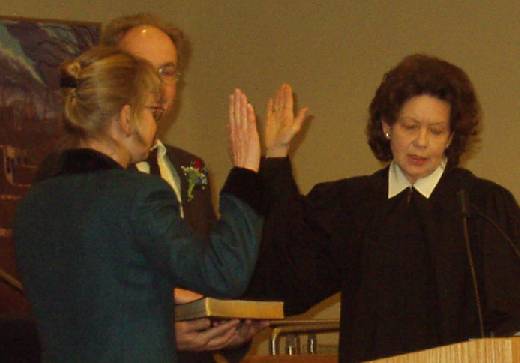
Justice Minzner swears in Judge Rudd, January 1, 2003
This column first appeared in the Albuquerque Journal, Business Outlook on September 20, 2007. Reprinted with permission.
Remembering Justice Pamela Minzner
by Judge Merri Rudd
Over the past few weeks, you have probably read or heard about the death of New Mexico Supreme Court Justice Pamela B. Minzner. A list of her awards, accolades, and accomplishments would fill several columns. From those professional summaries, one might not know that Pam, as she instructed everyone to call her, was the nicest woman one could ever hope to meet.
I know because Pam Minzner cheerfully mentored me for over twenty years.
I met Pam in 1986 when I clerked for Judge William W. Bivins on the New Mexico Court of Appeals. Pam was also a Court of Appeals judge at that time. She treated me, a young, inexperienced law clerk, with inordinate kindness and respect. She patiently helped me to analyze legal issues, offered me her last $5 for lunch, and insisted that I take her umbrella to go to the commuter van because it was raining. (I declined.) And she was not even my boss.
Over the years she counseled and inspired, prodded and supported me. At times she believed in me more than I did in myself. She encouraged me to strive to be intelligent but intelligible, accomplished without being arrogant, and true to a high standard of ethics, no matter what. She taught me that generosity of heart is the greatest strength any of us can aspire to have.
She urged me to keep trying after I lost two bids for probate judge. She jubilantly swore me in with a few days’ notice in 2001 when I was appointed by the Bernalillo County Commission to fill the vacant position. Again, in 2003, she made time to swear me in before dashing off to attend the Governor’s inauguration. Although I presided over a small county court and she served on the highest court in the state, she made no distinction about our relative positions. Pam’s world view did not include a hierarchy.
How proud she was when I presented two of my former students to the Supreme Court for admission to the state bar as new attorneys. She had taught me how to mentor others.
Pam grappled with each case before her, meticulously crafting judicious decisions and dissents that were well-grounded in the law. Sometimes we debated ethical issues at length, playing devil’s advocate to each other and ultimately adopting the highest standard of ethics, even if that was more than the rules required.
In 1999, when Pam became the first female Chief Justice of the New Mexico Supreme Court, she said in her speech, “This higher standard [of professionalism] is neither a matter of ethics nor a matter of malpractice. It is a standard that we ought to aspire to as a matter of life-long commitment. It is a journey without hope of official reward or fear of official sanction. We are looking for a better way…doing right for right’s sake.”
I have kept this quote on my wall for eight years.
Pam embodied many qualities: generosity, humility, humor, a community spirit, a positive attitude, a simple approach to life, independence, perseverance, and devotion to family, friends, cancer survivors, students, and colleagues. Pam managed her cancer and its complications for twenty years, conducting herself with dignity, grace, and a quiet appreciation for the present. She was gracious, considerate, and nonjudgmental. The arrogance that often accompanies power was absolutely absent in her. Her keen mind melded with a compassionate heart. She assumed the best of everyone, even those who might not have deserved her compassion. As Pam’s son said at her memorial, she lived a life that was meaningful, perpetually reflecting on whether she could have done better.
Pam led always with her heart and her intellect, not her ego. Would that we could all learn to be so selfless.
I was only one of those whom Pamela Minzner mentored. There are thousands of other people whose lives Pam influenced, inspired, and touched. Send your stories and remembrances of Pam, both personal and professional, to me at jueznm@aol.com, and I will compile them for Pam’s husband Dick and her sons, Max and Carl.
The last time I spoke with Pam was May 6 of this year. She called me at home to discuss a work matter. We talked for over an hour about the law, the judiciary, her illness, my future, her future, and her family. Although it was Sunday and we both had other obligations that day, she talked as though she had all the time in the world.
I wish she had.
Postscripts:
Chief Justice Mary Mullarkey, Pam’s Harvard Law School roommate, wrote an enlightening article about women at Harvard Law. The article is posted at:
http://www.law.harvard.edu/students/orgs/jlg/vol27/mullarkey.php
State Bar of New Mexico, Bar Bulletin, Oct. 29, 2007: Scroll down to page 15 for a touching tribute to Pam from many sources.
Selections from Pam’s memorial, held at UNM’s Popejoy Hall on September 8, 2007:
Reverend Albertson or Rath said that Pam worked for justice in the law and for social justice. She lived this extraordinary welcome in both her personal and professional life. He spoke of lessons, such as, “Do not claim to be wiser than you are. Live peaceably with all. Your love must be completely sincere.” He concluded that Pam did all of these in her daily life.
Anne Bingaman remembered that when Pam was teaching full-time at the UNM School of Law and working up until she gave birth, this was no big deal, even though it was in the 1970′s and not a usual choice back then. “Of course, women can do it all. Pam was always directed to others. It was never about her.”
Pam’s son Carl said she knew how to live a life that was meaningful, of service, love, kindness and generosity. She perpetually reflected on everything–could she have done better?
Her younger son Max said that as a role model Pam was extraordinary, the most modest, patient and kind person who always assumed the best of everyone. She never wanted to criticize, was joyful in hope, patient in affliction. He lost his mother, but he will keep her always as his role model.
New Mexico Supreme Court Justice Edward Chavez noted that Pam always ended her speeches with “Adelante,” Spanish for “keep moving forward.” Pam was a cancer survivor and a tireless legal scholar, She did what was right, and she gave the Court the discipline of her editing. She had a reservoir of genuine thoughtfulness and was constantly evalutaing herself. When asked if she had left anything undone, she said “no.”
Pam’s memorial service ended with the Reverend Francis Rath saying, “Harry Lauder, a famous opera singer, used to tell a story of his boyhood in Scotland. He liked to look from the window of his home during the gathering twilight, and watch the work of the lamplighter with his long pole. The man went from street lamp to street lamp as he ascended the hilly road, leaving a trail of lights behind him. Then, as the road sloped downward, the lamplighter disappeared from view. Someone has suggested that THAT is the pattern of a life well lived; someone who has left behind them a trail of lights. Pamela Minzner left behind a long trail of lights. Do not let those lights go out. May her memory and spirit be with us now and forevermore. Amen.”
Amen, indeed.
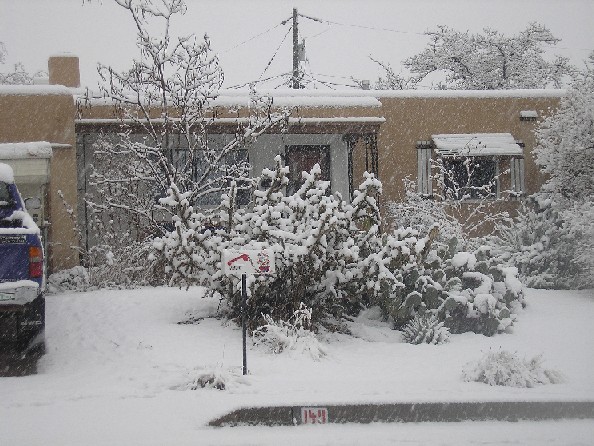
Snow Day
December 19, 2006 on 3:29 pm | In AlbuquerqueFrom our house to yours…wishing you the happiest of holidays!

Taken moments ago, December 19, 2006, 3:15 p.m., Albuquerque
Speaking of snow, check out the oh-so-clever “I’m Dreaming of a White Christmas” at http://badaboo.free.fr/merryxmas.swf If that link won’t work for you, try www.thecompassgroup.biz/merryxmas.swf
A Splendid Celebration!
December 17, 2006 on 7:32 pm | In Albuquerque, Monthly Folk eNews
The 100 or so musicans and dancers who attended last night’s music and dance party at the Heights know what a fine, festive, food-filled and fun-filled evening it was. Merri called her favorite dances over the past 15 years, including Karen & Greg Tie the Knot, Trip to Phan Reel, M.A.D. About Dancing, and Chuck the Budgie. Ken Cooper called two dances, which allowed Merri to dance with her hubby Mark. The Megaband added the old-time versions of Jingle Bells, Deck the Halls, and We Wish You a Merry Christmas (did you know it was a waltz?!) to their repertoire. We still had two lines of dancers at the end of the night, and many of them were seen smiling all evening in their holiday finery. A smorgasbord of food and drinks lined the entire wall of the other room.
We would love for you to share your music and dance memories (recent or distant), thoughts, good wishes, stories, and/or reflections about last night, etc. by posting a comment on this blog entry (scroll to bottom of this post to comment). To you who shared food and drinks, played rowdy dance tunes, danced beautifully, cheered enthusiastically at each announcement, and recorded the event, THANK YOU! from all your hosts and hostesses: Merri, Melissa, Lew, Bob, Nancy, Ken, Michele, Kelly and Gina.
For those who were unable to attend, here are the anniversaries and occasions we celebrated:
Merri Rudd, 15th anniversary as a caller (called her first whole dance on December 7, 1991 at Lloyd Shaw with Megaband playing).
Melissa Wilson & Lew Suber, 15th anniversary as a couple. (Their 2nd date was at that 1st dance Merri called. Melissa, who was the caller scheduler at that time, hired Merri.)

Here’s Melissa & Lew dancing on December 16th
Bob & Nancy Ford, 15th wedding anniversary is Dec. 31, 2006, and Merri forgot to mention this last night, so sorry! Bob’s been our ace sound guy for years.
Michele Von Boeck & Ken Cooper eloped during our thrift store prom at the 14th annual FolkMADness Camp in Socorro on May 28, 2006. Merri officiated.
Kelly Kellstedt & Gina Jenner eloped the next evening, May 29, 2006, in Anita Shenkman’s backyard, Eva Ceskava officiating.

Karen & Greg, the 1st folk couple to be married by Merri; Michele & Ken; Merri; Gina & Kelly
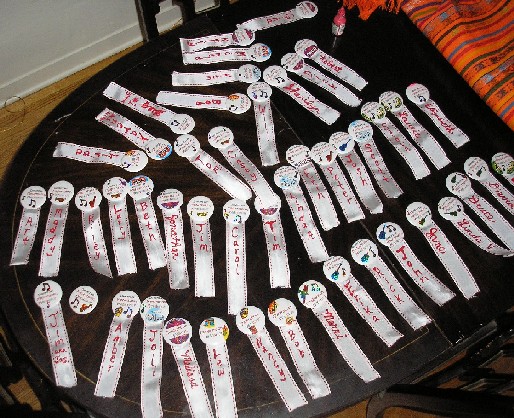
Honoring the Award-Winning Megaband, who has played for our dances for free for 30 years. We gave them “awards,” which we hope they can wear for years to come. Fiddler Jane Phillips helped Merri figure out all their names.


Megaband members making merry music!

Honorees’ hand-crafted “awards”
It was also Dennis Vik’s birthday on December 17. He is only slightly older than 15.
That’s my brief report on the evening. Look forward to reading folkies’ comments on this blog!
Merri Rudd
www.merridancing.com
PARRRR-TY! December 16, 2006
October 16, 2006 on 6:58 pm | In Albuquerque, Monthly Folk eNews, Santa FeWhat started out as one small celebration has blossomed into half a dozen events. Come see for yourself who’s celebrating what on Saturday, December 16, 2006 at the Heights Community Center, 823 Buena Vista SE, Albuquerque. We’ll also be honoring the Megaband musicians that night.
Click here for the colorful invitation created by Nancy Ford.
Cheers,
Merri
merri@merridancing.com
Thank You, Musicians!
October 13, 2006 on 7:32 pm | In Albuquerque, Huzzah!, Santa FeMusician Appreciation by Dancers (MAD)
This article first appeared in the New Mexico Folk Music and Dance Society (FOLKMADS) newsletter, Vol. 9, Issue 6, November/December 2006. It was then picked up by the Country Dance and Song Society News, Issue 194, January/February 2007, page 12. It has been reprinted in various folk music and dance newsletters around the country.
Ideas for Dancers’ Consideration
By Merri Rudd, merri@merridancing.com
A very long time ago, a musician told me, “You are one of the few who think the musicians are important. You appreciate us.”
“Important?!” I exclaimed, “It is because of you that dance is possible.”
As a caller, I have spent a lot of time attending band practices and on stage, thinking about the role musicians have in driving the dance. The music energizes, inspires, and wallops the dancers’ senses, inciting movement, excitement and, with a little luck, magic.
In the early days of New Mexico’s FolkMADs dances, the Megaband always provided the music. In 1990 the organization began to pay bands, but those fees don?t amount to much. The reason you see band members on the stage is because they love the music and playing for lively dancers. The best reward for a dance musician is seeing, hearing, and feeling the dancers’ excitement, so don’t hold back.
Albuquerque and Santa Fe Megaband musicians have played for dances for more than 20 years free of charge. Their donation of services has allowed FolkMADS to save thousands of dollars to buy complete sound systems for both communities, host special events, and cover losses when some dances have low attendance.
So, as dancers, how can we express our appreciation for the rowdy dance music so willingly provided by the bands? How about:
1. Clap enthusiastically after each tune. Seasoned bands deserve your praise; newer bands need your encouragement.
2. LOOK at the musicians on stage. When you progress to the top of the dance line and stand out for 32 seconds until you become active, take this opportunity to admire the musicians on stage. Note which instruments they?re playing. Without distracting them too much, smile or tap your foot or clog or do whatever else will show you appreciate their rhythms and tunes.
3. If a particular tune revs you up, whoop and shout from the dance floor. Bands love the synergy that comes from knowing their tune fit a particular dance so well that the dancers couldn’t help but holler.
4. Bring the musicians homemade treats to help fuel them throughout the evening (no sticky buns or other items that will mess up their strings or fingers). You try maintaining a consistent energy and strong dance tempo for 3 hours without refreshment; they need fuel just like other fine machines.
5. If refreshments are served at a dance, let the musicians have first dibs. They’ve earned the right to “eat first.” Plus, they must be back on stage in just a few minutes.
6. If you see musicians milling about during the break, don’t be timid. Go up to them and thank them for their time and music. If you have especially enjoyed their tunes, let them know! Most musicians don’t bite and are flattered to hear from you.
7. Sometimes less-experienced or shy or quiet Megabanders find themselves in uncomfortable lead musician roles due to competing commitments of other musicians. They may be the only fiddler or guitarist for the first time in their lives with the great responsibility of leading the melody or rhythm for the entire dance. These musicians especially need you. If you observe a new musician face, a fearful face, or a face with visual cues that signal a need for help, give them extra support, encouragement, and appreciation at the end of each tune. (Do this for new dancers too!)
8. Whatever you do to express appreciation, do NOT rush onto the stage. We old-timers will always remember when a caller suggested someone might kiss the fiddler in the middle of a square dance and broke the fiddler’s bow in the process. Respect the musicians’ instruments and space.
9. Some bands have CDs; shell out the $15 to support these artists. Yes, they almost all have day jobs. But their music is a labor of love; they deserve your support.
10. At the end of the night, gather at the edge of the stage and clap prolongedly and fervently. Our dances are homemade fun and we should always remember how special that is. You’d surely thank your grandma for that great homemade pie; don’t forget to thank your local musicians for those great homemade tunes! Remember, it is because of these musicians that dancing is possible.
Email me with other ideas about how to express appreciation for our musicians, and I’ll post them on this blog. Thanks to Albuquerque musician Jane Phillips and Santa Fe musician Will McDonald for helping me with this post.
(c) 2006 Merri Rudd, All Rights Reserved, www.merridancing.com
Joyce Briscoe
September 21, 2006 on 3:26 pm | In Albuquerque
Joyce, Dec. 2005, after receiving ACLU Volunteer of Year Award
Photo by Merri Rudd, (c) 2006, All Rights Reserved
A reunion for Joyce is planned for Friday, November 3, 2006, 3-7 p.m., Hispanic Cultural Center, Albuquerque. Click here for details.
Joyce Briscoe, 56, and her long-time friend and colleague Allys (Alice) Brice, 63, died when their car collided with a semi-truck on September 13, 2006. You can read the words, imagine the gruesome, and feel the kick in the heart pretty easily by viewing the news articles about their deaths.
What you can’t know are the numbers of lives that Joyce and Alice touched and changed and inspired over the span of 30 years. I did not know Alice; I knew Joyce. And I cannot let the untimely death of Joyce Briscoe go by without comment.
Joyce was a tireless advocate on behalf of human and civil rights, well-known within and outside of the legal community. She volunteered thousands of hours to help protect the ideals she held so dear. Peace, justice and equality were not just abstract concepts to Joyce; she worked nonstop to enact positive change within our community. She volunteered nearly full-time at the American Civil Liberties Union (ACLU) office in Albuquerque, for free, for fun, for conviction when she didn’t have to do a darn thing. She was “retired,” after all. She chose to volunteer, she chose to contribute, she chose to stay vigilant in today’s troubled times.
Joyce revered the U.S. Constitution, the legal and judicial systems, and the basic rights that formed our nation’s foundation. She was informed and engaging. She was never complacent, always hopeful. Even those who disagreed with Joyce probably liked her. Joyce packed more life and action into her 56 years than most of us could accomplish in several lifetimes.
Joyce also taught school for 25 years. I imagine she taught countless students to think independently and to analyze all sides of an issue before taking a position. She supported unpopular positions, based on principle. She lived with integrity. She did right for right’s sake. One of Joyce’s former students posted an eloquent and insightful tribute to Joyce at:
http://www.tinkertownblog.blogspot.com/ (Remembering Joyce Briscoe, September 17, 2006). Still other students posted rememberances on the Albuquerque Tribune blog site link listed above.
Those of us who knew Joyce personally can attest that she radiated goodness and genuine care for others. She was feisty and fun; she had a compassionate heart and a resolve of steel. Whether Joyce was teaching, taking a yoga class, blogging about civil liberties, or organizing major community events, she did so with fervor and flair. May we all live our finite lives with the grace and joy and passion with which Joyce Briscoe lived hers. She deserved at least 30 more years of rabble-rousing, conscience-raising, and spirited discourse.
The glowing (and sometimes hyperbolic) adjectives that people use when describing those who have died will not be exaggerations in Joyce’s case. She was a remarkable and classy lady. We who count ourselves among her family, friends, students, and colleagues are utterly heartbroken by her absence. The best we can do to honor Joyce and Alice is to keep trying, to keep working, to keep hoping for better times.
Other tributes:
Former Albuquerque Mayor Jim Baca has posted a blog entry at: http://onlyinnewmexico.blogspot.com/2006/09/loss.html
Portions of this blog entry first appeared in the Albuquerque Journal, Business Outlook Section, “Ask the Probate Judge” column on Thursday, September 21, 2006. Reprinted with permission.
Judge Merri Rudd
Bernalillo County Probate Judge
merri@merridancing.com
THE Bird Find of a Lifetime!
February 22, 2006 on 8:20 pm | In Albuquerque
Photos by Mark Justice Hinton (c) 2006
New Photos posted on full blog at www.merridancing.com/wp (see especially photo posted 3/14/06 March 2006 Folk Enews, 2nd Half)
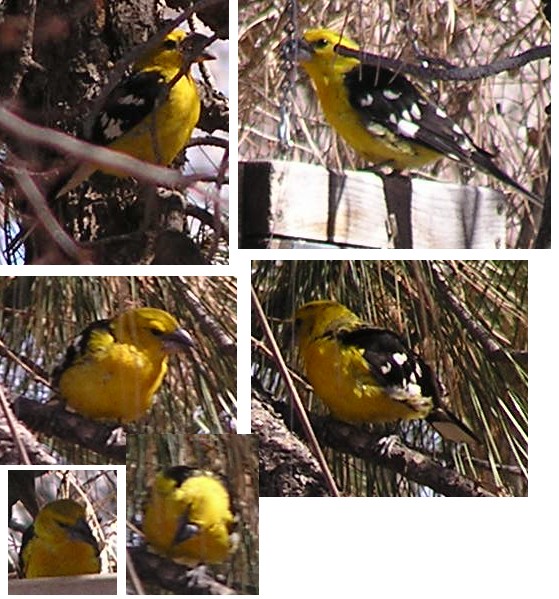
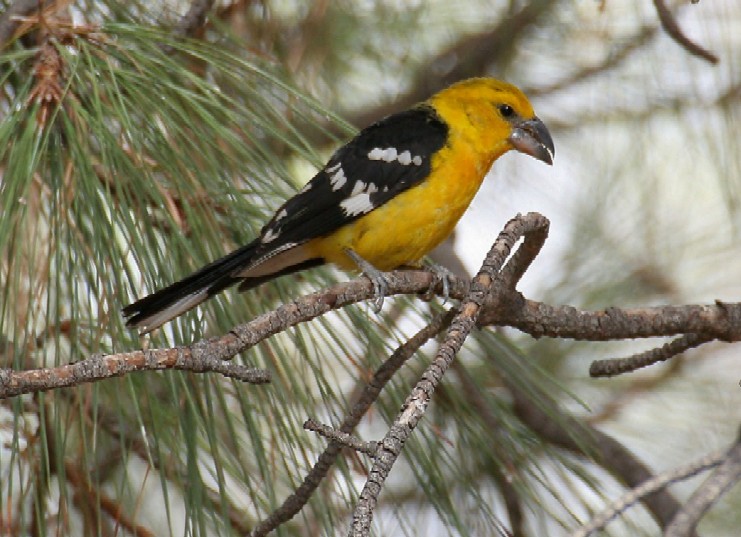
This all started when my court administrator Lori gave me an article from the Albuquerque Tribune about a rare sighting of a yellow grosbeak. If you read the Sibley Guide to Birds, you will learn that the yellow grosbeak normally lives in Mexico and points south. Sibley states, “There are few confirmed records of Yellow Grosbeak from Arizona, despite many reports. As always when reporting such a rare bird, take extra care in the identification and be sure to eliminate all similar species….” Until a few weeks ago, there were no known reports of yellow grosbeaks in New Mexico, ever.
I had heard about this grosbeak in January 2006 when our friends Dave Mehlman, an ornithologist with the Nature Conservancy, and Kathleen Hall came over one Saturday. That morning they had been in the yard of Ray Powell, a veterinarian, environmentalist, candidate for state land commissioner, and friend of mine, who lives across the road from Dave and Kathleen. Apparently, the bird was making quite a stir and had attracted about 30 or 40 folks, including our teenage neighbor Michael Hilchey, there to observe it.
Then I read the Tribune article. It so happened that Dave Mehlman, who is also an ace contra dancer, was giving a talk at the Natural History Museum’s Dynamax Theater on Tuesday, February 21, about the ivory-billed woodpecker recovery project. [Aside: Dave is on the national recovery team for the ivory-billed woodpecker, and we're very proud of him.] I told Dave I would bring him the article from the Tribune, which he hadn’t seen.
A young woman named Laurel with the New Mexico Audubon Society was sitting in front of us in the Dynamax, along with Turtle Bear Guillermo who also dances with us on occasion. Laurel overhead us talking about the article and said, “The grosbeak moved to 1412 Las Lomas. I saw it there this afternoon.” “Really?!” I said, “Our friends live at 1601 Las Lomas.” About that time, Melissa and Lew, who live at 1601 Los Lomas and are also dancers, walked into the theatre (we didn’t even know they were coming). We passed them the article and decided we’d go see Lew today and walk down to 1412 to look for the bird.
As small town Albuquerque goes, 1412 Las Lomas NE turned out to be the home of Kay Bratton, an attorney I’ve known for more than 20 years! Mark, Lew and I went there at noon with burritos from Golden Pride. Kay had left a sign in the front with instructions about where to sit and where to look. We went in the backyard and settled around the patio table. Her signs didn’t tell us there was a “vicious guard dog”!

Photo by Mark Justice Hinton (c) 2006
Actually, he was darling and his main objective was to beg for burrito bits and to try to drag the lunch sack off the table. Kay’s backyard also has a covered swimming pool, so be careful not to step on the cover and fall through into the water.
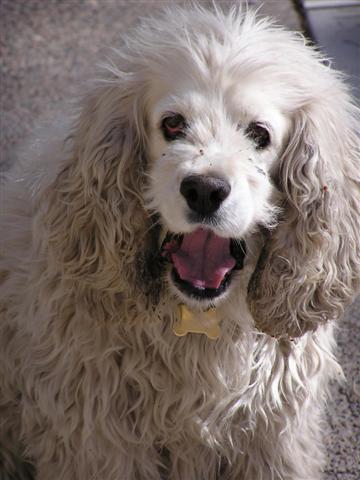
After 10 or 15 minutes of watching, I saw a large bird with white patches on his wings land in the pine tree above the feeders. “I think he’s here,” I told Mark and Lew. A few minutes later, the grosbeak hopped down and settled onto the seed tray with the sparrows and finches for some sunflower seeds. We saw him three times in the half hour between 12:30 and 1 p.m. Mark took several photographs and created the above collage. Identifying a yellow grosbeak is like identifying a bald eagle–even for casual birders, the yellow color and thick parrot-like beak are bulls-eye field marks. We felt a little guilty at how easy it was and how lucky we were, but we relished our brief foray into birding history. The day was truly charmed. My hubby posted his unique views about birding at http://www.edgewiseblog.com/mjh/index.php (“Bird Man of Albuquerque, no, not me!,” posted 2/22/06).

Photo by Mark Justice Hinton (c) 2006
We also saw juncos, several ladder-backed woodpeckers, and a spotted towhee. Kay came home to go to a dentist appointment and invited us inside where we signed the guest book. A dozen or so people had signed in today. On our way out, we met a couple from out of town who had heard about the bird. We gave them instructions, including “don’t let the dog out of the yard,” and headed home.
I love this town.
P.S. Melissa, Lew, Mark and I saw the grosbeak again last Friday. February 24. He is a very accommodating rare bird. And a few weeks later, a visiting Californian took this shot:

Photo taken on March 11, 2006 by Matthew Matthiessen, Ukiah, CA, who visited the bird in Albuquerque, (c) 2006
Hands Five Brings Down the House
February 6, 2006 on 10:11 pm | In AlbuquerqueThanks, everyone, for showing up at the February 4 Albuquerque contra dance. Nancy Ford reports that “Officially, the count was 96. “ That is an AMAZING number of dancers. Forty dancers filled two lines during the newcomer’s class. A bunch of them were in their 20′s and 30′s, yet another shocking development. We oldies are thrilled, of course, to see some young ‘uns (at this point anyone under 50 is young to me). We still wish more of the dancers were men, but there were fewer women sitting out this time than at the last dance. Maybe word will get out and even more guys will show up next time. All we want is a little gender balance.
If we can’t have that, I would be willing to teach a “how to dance as a man” workshop for women. We might invite the men too and let them dance as the women. A few women have asked me about doing this because they’d rather dance the man’s part than sit out and miss the fun. We could do the workshop one Saturday afternoon, have a potluck dinner, and then attend the regular dance and show off our newly learned skills.
Hands Five got rave reviews for their interesting and lively tunes. They wove creative trills and accents into the tunes, including a snippet of “Hava Nagila.” The fiddler’s wife was even spotted kicking up her heels on the dance floor!
We still had two lines of dancers at the end, including several of the brand new dancers. But the finest compliment of all came from a woman from New York. She was passing through New Mexico with her teenage granddaughter, who also danced. At the end of the night, she came up to me and the band and said, “Thanks for a wonderful evening! I never expected to stumble upon such an excellent dance in New Mexico!” I guess we have known all along how fun and friendly we are. It’s nice to know that out-of-staters are finding out too.
If you missed Saturday’s dance, Hands Five and I will be doing Santa Fe’s contra dance on April 8, 2006.
Powered by WordPress with Pool theme design by Borja Fernandez.
Entries and comments feeds.
Valid XHTML and CSS. ^Top^